
“Newburgh and The Nation” Essay
A Picture is worth 1,000 words, so here are 1,401:
A Historical perspective of “Newburgh & the Nation: The Paintings of John Gould”
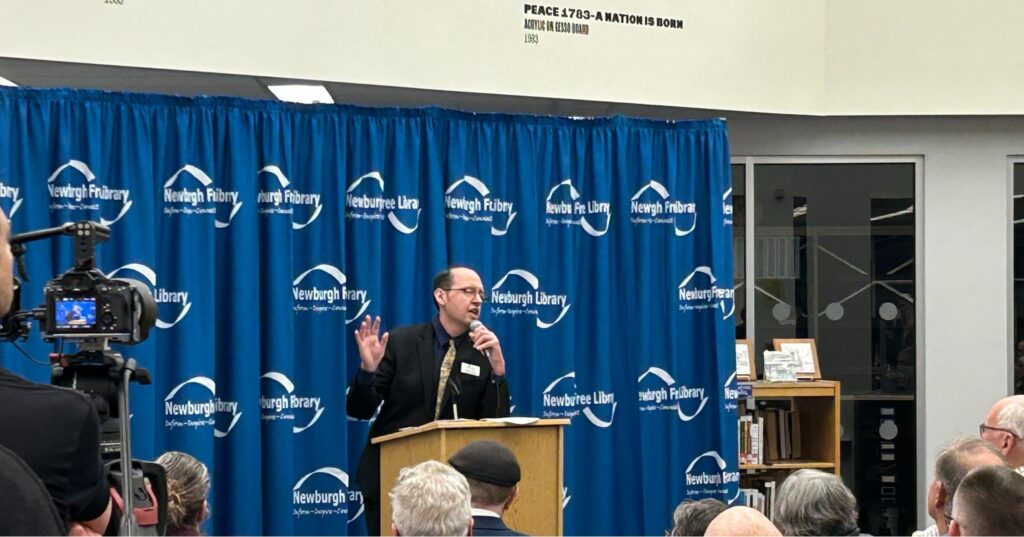
Speech given at Opening Reception on 10/16/25
by Matthew Thorenz, Local History Librarian, Newburgh Free Library
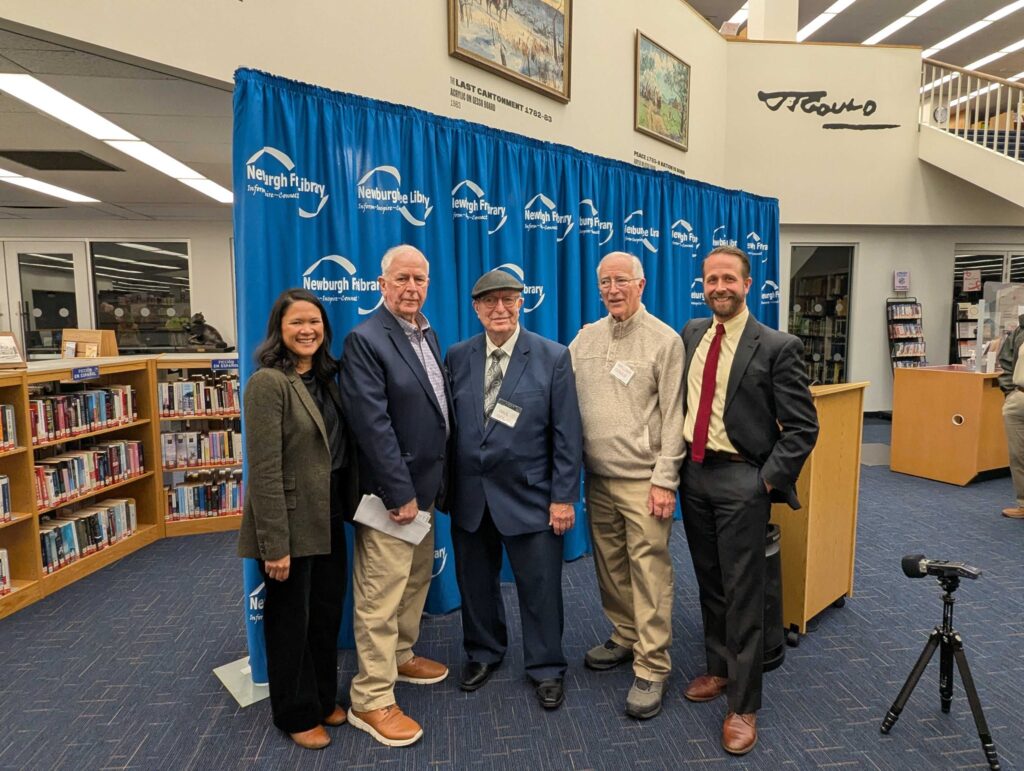
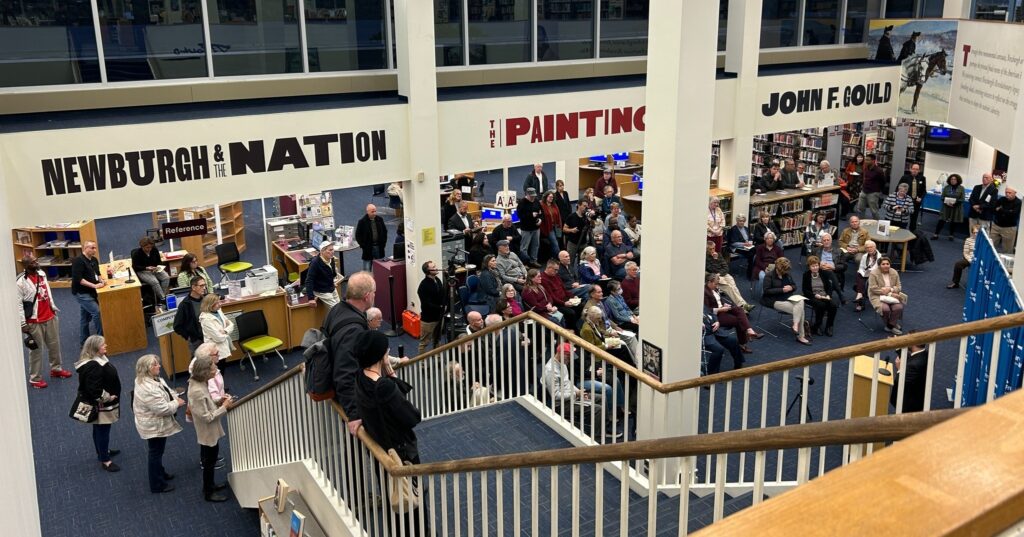
Our library is honored to highlight three paintings that document an important part of our local, and national history. Through the brush strokes of John F. Gould’s trilogy of paintings: “The Last Great March-1782”, “The Last Cantonment – 1782-83”, and “Peace-1783 A Nation is Born”, we can see his interpretation of the story of the last encampment of George Washington’s Army; a pivotal moment where the war for our independence ended, and the debate over how our new nation would be governed began.
It’s an old, but true cliché that “A Picture is worth 1,000 words”, and to discuss the history being documented in each painting can take up an entire book (our Local History Collection has several), but I think it’s good to provide some historic background to put these paintings in their proper context! We often think about history as a retelling of events that have already happened, viewed with some level of hindsight, a detachment people who lived through those events did not have. As depicted in “The Last Great March-1782”, when the Continental Army arrived at New Windsor in October, 1782, they had no idea a general ceasefire would be announced less than 6 months later. After the Siege of Yorktown in 1781; an event many Americans assume was the end of the war, Washington brought his army to the Hudson Valley. They weren’t here to pick apples and enjoy award winning cuisine. Instead, they were preparing themselves for a potential siege of New York City, Britain’s last major stronghold in what would be the United States, as well as to defend the Highlands from British raids in Westchester and lower Rockland Counties. The war was not over for them.
By 1782, America’s War for Independence had expanded to continents and oceans far removed from the small Massachusetts towns of Lexington and Concord where it began almost 8 years earlier. The soldiers depicted in Gould’s “The Last Great March-1782” are uniformed in wool provided by our French allies, paid in currency loaned by Spain, and supplied with powder produced in the then Dutch colony of Saint Eustatius. The involvement of France, Spain, and the Netherlands on the side of the United States in 1778 and 1779 widened the scope of our revolutionary war beyond our shores to Honduras, Nicaragua, Gibralter, and Southeastern India, where the last shots were fired in September, 1783. These were allies and battlegrounds the soldiers of Washington’s army would never imagine having, nor learning of, when our rebellion against Britain, one of the most powerful nations in the world began.
In the second painting, “The Last Cantonment-1782-83”, Washington’s soldiers are preparing themselves for a long, cold winter by building huts along what is now New York State Route 300, and I-87. A total of 8,000 men, women, and children from New York, New Jersey, Massachusetts, New Hampshire, and Maryland, made this area their winter home, briefly making it one of the largest concentrations of people in the 13 United States. Although population information for this period is hard to come by, the combined total population of Newburgh and New Windsor would have numbered less than 2,000 people.
Unlike their first winter encampment at Valley Forge in 1777-1778, Washington’s Army was prepared for its winter at New Windsor. The huts were measured out to be 18 feet long and 35 feet wide, divided into two separate rooms, each hut was designed to fit a total of 32 soldiers. Their occupants included second generation descendants of the pilgrims, newly arrived immigrants from Ireland, African Americans; serving as free men, or as substitutes if they were enslaved, and women like Deborah Sampson; who covertly defied gender norms of the time to enlist in the Continental Army under the moniker “Robert Shirtliff”, and Blooming Grove native Sarah Osborne, who marched alongside her husband as a laundress, and gave birth to their daughter Phoebe while encamped here. All of these individuals fought, died, and served alongside each other, in the only integrated army the United States would have until 1948.
The leader of this army, George Washington, would make the home of Trintje (Catherine) Hasbrouck his headquarters for 16 months, Martha Washington soon joined him. From this modest home, seen in “Peace-1783 A Nation is Born”, Washington, and his subordinate officers, grappled with the daily minutia of keeping this army in line, while he transitioned from a leader of an army, to a leader of a nation. In May 1782, Washington received a letter from Lewis Nicola, an officer in the corps of invalids, at West Point. This letter, a critique of the Articles of Confederation, America’s form of governance that only came into being a year before, included a suggestion by Nicola that in order to strengthen the present form of government: “I believe strong argument might be produced for admitting the title of king, which I conceive would be attended with the same material advantages”. Washington responded to Nicola’s letter that day: “No incident in the course of war in me triggers painful feelings as your message, that such ideas are circulating in the army as you expressed it”. Nicola apologized the following day, not once, but twice. Washington’s point was made. There would be no place for kings or autocrats in this new nation. In March, 1783, Washington intervened to break up a potential mutiny, not by his enlisted soldiers, but by his officers, who threatened to hold the Continental Congress hostage until they were properly paid with money the Congress did not have, a shortcoming stemming from the Articles of Confederation. On March 15, 1783, at a meeting held at the Temple of Virtue, the cantonment’s main administrative building at New Windsor, Washington admitted that he too had sacrificed, giving his health, and age in the service of a noble cause with an uncertain outcome. This simple act not only shamed his officers, but fortified them to not throw away the ideals of the revolution they had fought so hard to win. One month later, on April 19, 1783, the eight-year anniversary of the first shots of the Revolution being fired, the general cease fire was announced at that same place. The war for Washington, and his army, was all but over, but their role in creating a new nation had just begun, right here in Newburgh.
We often think people who lived through a momentous event like the creation of a new country would immediately reflect and preserve what they accomplished. Many did, others did not. People then as now “are people”. Shortly after the discharge of the army in June, the huts they constructed to keep warm through the winter, the Temple building in which Washington delivered his “Newburgh Address”, and other structures were auctioned off for building materials; the proceeds went to soldier’s wages long overdue. The land reverted to pastureland for cattle. The Hasbrouck home returned to the family after Washington’s departure. In late 1781 when Catherine was told her home was chosen to be Washington’s Headquarters, she was described as being “sullen”, you would too if a group of strangers chose to live in your home for an unspecified amount of time. Once their unexpected guests left, the family just wanted to move on with their lives. The home was nearly lost to time until a campaign by Newburgh’s leading citizens led to the purchase of the property by the State of New York. It would open as the first publically funded Museum in the United States on July 4, 1850. Knox’s Headquarters, as well as New Windsor Cantonment would follow nearly 70 years later. All of these sites are focal points for John F. Gould’s paintings.
When you’re living through an historic event, the last thing on your mind is how you will be remembered in two-hundred years. There are many stories these paintings by John F. Gould can tell us about the last crucial months of our war for independence, but the one that speaks to me is how a diverse group of individuals came together in one place to help create something new. In his September 2025 essay entitled “Turning Point” American journalist Anand Giridharadas stated that “Democracy is, in the beginning and in the end, a belief that we can live together despite difference and choose the future together. When someone asks me where did our nation begin, my answer will always be “Newburgh, New York”.