
Library Policies
Mission Statement
Our mission is to inform, inspire, and connect our diverse community. We provide
free, equitable access to cultural, technological, and educational enrichment and
resources.
Code of Conduct
The basis for conduct in the Library is respect for its use, by all patrons and staff.
Patron Code of Conduct
A. Principles, Responsibilities and Process
The Board of Education establishes the rules for public behavior in the Library which are
necessary:
● To protect the rights of individuals to use Library materials, facilities, and
services;
● To protect the rights of Library employees and volunteers to conduct Library
business without interference;
● To ensure the use of the buildings, materials, and services by the greatest
number of individuals;
● To preserve those materials and facilities from harm;
● To ensure the safety of Library users, employees, and volunteers.
● To safeguard the privacy of Library users.
The Library Administration has the responsibility for maintaining order in the Library and enforcing the established rules. The Administration is responsible for posting the Patron Code of Conduct prominently in Library facilities.
In order to enforce the established rules, the staff will be required to intervene in
situations at the Library that present danger to the safety of persons or property,
interfere with the rights of others, and/or constitute inappropriate uses of the Library,
disorderly conduct and/or the commission of illegal acts.
Library staff will bring to an individual’s attention any act or omission which violates the Patron Code of Conduct and related Library or School District policies. Such an
individual will be asked to change his or her behavior to conform to the rules. If such a
change is not evident or forthcoming that individual will be asked to leave the Library
building and Library property. If the individual refuses to leave after being requested to do so, the police may be called and a charge of criminal trespass may be filed.
Depending on the severity of the violation, individuals who have been asked to leave
the building may be evicted and barred from returning to the library for varying periods
of time as outlined in a Library Suspension Procedure to be created by the Library
Director. Individuals who have had their Library privileges suspended may be required to discuss the violation with the Director or his/her designee before privileges are reinstated. Juveniles may be required to bring a parent or guardian for such a conference.
An individual suspended from the Library has the right to appeal that decision to the
Library Director as outlined in the Library Suspension Procedure.
B. – Rules
Appropriate behavior is required at all times, and patrons shall be engaged in activities associated with the use of a public library. Reasonable quiet is expected, especially in designated areas. No patron may disturb others using the Library. In the course of Library business staff may request a patron to provide proper identification. Failure to provide such identification may lead to removal from the Library.
In all emergencies and emergency drills patrons will follow all instructions from Library staff and emergency personnel. Failure to do so may result in arrest and loss of Library privileges.
Patron concerns should be brought to the attention of the appropriate Department or the Administration.
The following behaviors are prohibited:
● Leaving children and vulnerable adults unattended
● Unreasonable noise, including but not limited to: loud talking, singing, boisterous
activity/cell phone use in non-designated areas
● Take photographs, videos, or make recordings of Library patrons or staff without their permission
● Harassing patrons or staff. Deliberate repeated behavior that is hostile,
intimidating, threatening, offensive or adversely impacts staff work performance.
● Abusive or obscene language, racial, or ethnic epithets, slurs against gender or
gender preference
● Intentionally damaging, destroying, tampering with or stealing any property
belonging to the Library, another patron, or staff.
● Abuse, improper or unsafe use, or rearrangement of furniture, equipment or
materials
● Gambling, panhandling, soliciting money or contributions
● Monopolizing/obstructing space, seating, tables or equipment to the exclusion of
others
● Distributing/posting unauthorized printed materials. The Library reserves the
right to establish rules regarding posting and distribution based on time, size,
space and location.
● Bringing animals, other than appropriately certified and trained service animals, into the Library, except for authorized programming purposes. All animal owners
are liable for damage to persons or property caused by their animals.
● Smoking or vaping on Library property
● Eating in the Library
● Sleeping in the Library
● Bringing oversized items, luggage, or bedding into the Library
● Having bodily hygiene offensive so as to constitute a nuisance to other persons.
Such patron shall be required to leave the building.
● Entering the building without a shirt or other covering of the upper body or
without shoes or other footwear.
● Bathing in the public restrooms
● Entering staff areas without authorization
● Committing any act that would violate any State, Federal or local law, ordinance
or regulation, or the Newburgh Enlarged City School District policy “Public
Conduct on School Property.”
–Ben Gocker, Director
The Board of Education’s full policy regarding Conduct of Patrons in the Library is available upon request.
Staff Code of Conduct
The Newburgh Free Library is committed to ensuring that the Library is welcoming and respectful of all, including staff members. Our Library Staff Code of Conduct is rooted in the ALA’s Code of Ethics.
PATRON RELATIONS AND EXPECTATIONS
It is the policy of the Newburgh Free Library to provide the highest level of service to all library users through appropriate and usefully organized resources; equitable service policies; equitable access; and accurate, unbiased, and courteous responses to all requests.
Staff are expected to provide service that respects the dignity and privacy of library patrons regardless of race, ethnicity, age, gender (including identity and expression), religion, sexual orientation, disability, economic status, and other diverse backgrounds.
Staff are expected to protect each library patron’s right to privacy and confidentiality with respect to information sought or received and resources consulted, borrowed, acquired or transmitted. Staff should handle patron requests with the utmost discretion at public service areas.
ALL PATRONS CAN EXPECT:
- To find the Library and facilities clean, tidy, and in good repair.
- To find staff in highly visible locations to assist them.
- To be acknowledged with a friendly greeting.
- To be treated courteously and respectfully in a non-judmental manner.
- To receive knowledgeable and professional service, free of jargon.
- To have their privacy respected.
- To be treated as individuals with unique needs.
- To have open access to Library resources and instruction in their use.
- To find staff members that acknowledge patrons and refer patrons to library services and appropriate staff members.
The Library promotes development of these behaviors through supervisors’ coaching, staff development and training, and patron input.
WORKPLACE BEHAVIOR
MUTUAL RESPECT
- Staff treat one another with courtesy and professionalism promoting a positive work environment
- Staff treat co-workers and other colleagues with respect, fairness, and good faith
DISCRIMINATION AND HARASSMENT
- No staff member will intimidate, harass, or discriminate against any person on the basis of actual or perceived race, creed, color, weight, national origin, ethnic group, religion, religious practice, gender (including identity and expression), age, marital status, sexual orientation, or disability.
CONSTRUCTIVE FEEDBACK
- Staff accept constructive criticism as a necessary step in providing high quality service to the community.
- Staff seek collaboration and open communication in solving issues at the Library.
- Staff refrain from voicing critical comments about the Library, its employees, or its patrons in public areas.
View a PDF of this policy.
Governing Policies
Policy at the Newburgh Free Library is set and approved by the Board of Education of the Newburgh Enlarged City School District (NECSD). Some policies contained herein have been superseded by new policies or revisions.
View NFL Policies
Volunteer Policy
The Newburgh Free Library welcomes volunteers who are interested in contributing their time and talents to further the Library’s mission “to inform, enrich, and inspire people of all ages.”
The Library recognizes that the use of volunteers strengthens relations with the
community through positive participation. The Library encourages volunteers from all
backgrounds who are willing to share their time, skills, and experience to benefit Library patrons and facilitate the work of staff.
The Library will make judicious use of volunteers in a way that is mutually beneficial. Volunteers are required to follow all Library policies, regulations, and procedures, as well as applicable School District rules and policies. The Library accepts the service of volunteers with the understanding that such service is at the sole discretion of the Library.
Volunteers may be involved in many facets of Library operations, including, but not
limited to: assisting librarians, helping with clerical tasks, and assisting with or leading
programs.
Volunteer assignments depend on departmental needs and may be seasonal or limited to a one time project or event. Volunteers are meant to help, not replace, the Library staff. School age volunteers looking to earn community service credit may be appointed based on the availability of work at the time of application. Library staff responsible for assigning volunteers will identify appropriate tasks and/or projects as well as provide supervision and feedback.
- Volunteers will not be assigned to provide one-on-one tutoring, reading, or other
instruction of any sort to a minor. - No volunteer will have unsupervised direct contact with minors.
- Use of volunteers will not conflict with or replace any duly appointed and/or
authorized School District personnel or the duties/job responsibilities of such personnel - Volunteers will be required to wear appropriate identification at all times when volunteering at the Library
- Volunteers must be 15 years of age or older
- Volunteers between the ages of 15-17 will be required to have working papers
- Volunteers must sign in and out of the building
- Volunteers must maintain the confidentiality of all information learned about patrons and the Library
Library personnel who are responsible for tasks and projects that involve the use of
volunteers will identify appropriate tasks and time schedules for such volunteer activities as well as make provisions for adequate and appropriate supervision and evaluation.
Individuals wishing to volunteer must submit a volunteer application form along with a valid photo ID, two non-family member personal references, and disclosure of any criminal convictions. The Library Director or designee will be responsible for reviewing the application, contacting the references, and interviewing the applicant to determine if the individual is appropriate to volunteer in a Library setting before approval. Once approved the application will be filed with the Human Resources Office. A criminal background check may be required of volunteer applicants. Any volunteer applicant with a previous criminal conviction must also be reviewed and approved by the Board of Education.
Accepting court-appointed volunteers is at the discretion of the Library Director. The
applicant will explain to the Director and Volunteer Coordinator the circumstances requiring services, including any pending charges or convictions as well as provide
documentation from their attorney or court officer.
Approved volunteers must sign a Confidentiality Agreement certifying that they will respect the privacy rights of Library patrons and abide by the Library’s Confidentiality of Library and Patron Records Policy.
All volunteers are required to follow Library and District policies, regulations, and
procedures. Any staff member who supervises a volunteer(s) who becomes aware that a volunteer has violated Library or District policies, regulations, or procedures must promptly report any violations to the Library Director and/or the Superintendent of Schools, who will determine whether to withdraw approval for the individual to provide volunteer services to the Library.
Any volunteer against whom an allegation of child abuse has been made will not,
pending resolution of the allegations, be permitted to render volunteer services to the Library.
The Library Director will be responsible for maintaining a current and complete list of all active, approved volunteers and their assignments.
This Policy will not apply to students who perform services for the Library under the
auspices of a college or university program in coordination with the Library.
Volunteers understand that the Library may at any time and for any reason terminate the volunteer’s relationship with the Library.
View a PDF of this policy.
Use of The Meeting Rooms Policy
As part of its mission to provide access to collections and services to the Newburgh
school community, the Newburgh Free Library provides meeting rooms in the library for use by individuals and groups.
Affirming Article V of the American Library Association’s Library Bill of Rights, use of
these meeting rooms shall not be denied or abridged because of origin, age,
background, or views.
The Newburgh Free Library makes meeting rooms available to organizations engaged
in educational, cultural, intellectual, charitable, advocacy, civic, religious, or political activities on an equitable basis, regardless of the beliefs or affiliations of individuals or groups requesting such use. However, the Newburgh Free Library does not advocate for or endorse the viewpoints expressed in meetings by meeting room users, just as the Library does not endorse the viewpoints of works in its collections.
Meeting Room Use Regulations
- Use of meeting rooms for Library activities shall take precedence over use by outside groups.
- Meetings or events held in library spaces must be open to the public.
- The Library does not collect fees for the use of library meeting rooms, and
organizations may not collect fees for participation in events or meetings in
library spaces. - The Library reserves the right to refuse room use requests based on the availability of space, the availability of staff to facilitate the meeting, and the
Library’s hours of operation. - All members of groups using the Library’s meeting rooms are responsible for abiding by the Library’s Patron Code of Conduct. Refusal to abide by the Patron Code of Conduct will not be tolerated, and may result in the revocation of meeting room use privileges.
- Food is not permitted in The Hub or E-Learning Center. Drinks in covered
containers or cups are permitted. - Event refreshments may be considered upon request and with approval from
Administration. - Groups will be responsible for leaving the room in a neat and clean condition, for putting all furniture back in place, and turning off the lights.
- Groups using the room will be responsible for any damage incurred by program attendees.
- Future use of the meeting rooms may be denied to any group that violates library policy or procedure.
- Reservation requests must be submitted at least 24 hours in advance using the Meeting Room Request Form on the Library’s website.
- Groups may reserve a meeting room no more than once a month.
- All publicity relating to events must clearly state that the event is not sponsored or endorsed by the Newburgh Free Library or the Newburgh Enlarged City School District.
- The Library is not responsible for publicizing the events of any individual or group using the meeting rooms.
- The Library’s address, telephone number, or email address cannot be used in any capacity – as an official address, or as contact information – by any individual or group using the meeting rooms.
- The Library is not responsible for any items brought to the Library by any
individual or group using the meeting room. - Individuals or groups using meeting rooms may not leave or store any materials or property in the meeting rooms.
- For room use involving children, there must be at least 1 adult present for every 10 children in attendance.
AVAILABILITY
Meeting rooms may be booked only during the Library’s open hours. The Library is not
available for public use after hours. If the Library closes due to weather or other emergencies, meeting rooms will also be closed, and any use will have to be rescheduled. The individual or group scheduled to use the rooms is responsible for notifying their members that the Library is closed.
Rooms that can be reserved include:
The Hub
E-Learning Center
Story Hour Room
Riverview Room
Room availability is subject to change.
EQUIPMENT
Any requests for technology or furniture arrangements must be made on the Meeting
Room Request Form and approved in advance.
Staff are not available to assist with equipment during events or meetings.
LIABILITY
The individual submitting the Meeting Room Request Form on behalf of a group will be responsible for the conduct and activity of the users.
Failure of any group or individual to abide by the Library’s policies relating to meeting
room use may result in the revocation of room reservations and the denial of any future use.
View a PDF of this policy.
Computer Use, Internet Safety, and WiFi Access Policy
The Newburgh Free Library is committed to ensuring access to information through
computers and the Internet. Access to digital information is fundamental for supporting
continuous lifelong learning. Recognizing its role to provide access to computers and
the Internet, the Library provides free access to any person, regardless of age or residency.
Public computer access may be unavailable or available with limited or restricted use in
compliance with relevant laws, Executive Orders, and public health and safety
guidelines.
COMPUTER USE
All computer use requires a valid Newburgh Free Library (NFL) or Ramapo Catskill
Library System (RCLS) library card. Patrons who do not have a library card may request
a Guest Pass from any service desk. Distribution of Guest Passes may be limited due to computer use and is at the discretion of Library staff. Using another person’s library card to gain access to the library’s computers is a violation of NFL policy and may result in suspension of computer privileges.
Patrons using computers must abide by all rules of behavior outlined in the Patron Code of Conduct.
Parents/guardians are responsible for any damage done by their children and for their
children’s general behavior. Parents/guardians of children under 18 years of age are solely responsible for the Internet information selected or accessed by their children. Only parents/guardians may restrict their own children from access to internet resources. Parents/guardians are advised to discuss Internet safety and to supervise their children’s Internet sessions to ensure their safety and privacy.
INTERNET SAFETY
In compliance with the Children’s Internet Protection Act (CIPA), and in order to remain eligible for certain federal funding, it is the policy of the Newburgh Free Library to (a) prevent access over its computer network by minors to, or transmission of,
inappropriate material via the Internet, electronic mail, or other forms of direct electronic communications; (b) prevent unauthorized access and other unlawful online activity by minors; (c) prevent unauthorized online disclosure, use, or dissemination of personal identification information of minors; (d) block access by minors to inappropriate information, especially visual depictions of material deemed obscene, or to any material deemed harmful to minors; and block access to child pornography.
Definitions
In accordance with the Children’s Internet Protection Act (“CIPA”),
● Child pornography refers to any visual depiction, including any photograph, film,
video, picture or computer or computer generated image or picture, whether
made or produced by electronic, mechanical, or other means, of sexually explicit
conduct, where the production of such visual depiction involves the use of a
minor engaging in sexually explicit conduct. It also includes any such visual
depiction that (a) is, or appears to be, of a minor engaging in sexually explicit
conduct; or (b) has been created, adapted or modified to appear that an
identifiable minor is engaging in sexually explicit conduct; or (c) is advertised,
promoted, presented, described, or distributed in such a manner that conveys the impression that the material is or contains a visual depiction of a minor engaging in sexually explicit conduct.
● Harmful to minors means any picture, image, graphic image file, or other visual
depiction that (a) taken as a whole and with respect to minors, appeals to a prurient interest in nudity, sex, or excretion; (b) depicts, describes or represents, in a patently offensive way with respect to what is suitable for minors, an actual or simulated sexual act or sexual contact, actual or simulated normal or perverted sexual acts, or a lewd exhibition of the genitals; and (c) taken as a whole, lacks serious literary, artistic, political, or scientific value as to minors
Responsibility for a child’s use of the Internet rests solely with the child’s
parent/guardian. The display or transmission of obscenity, child pornography, or materials harmful to minors is illegal and is strictly prohibited. Such displays or transmissions may result in appropriate legal action including suspension of library privileges and/or law enforcement intervention.
To the extent practical, technology protection measures (or “Internet filters”) will be used to block or filter the Internet, other forms of electronic communications, and access to inappropriate information. Specifically, as required by CIPA, blocking will be applied to visual depictions of material deemed obscene or child pornography, or to any material deemed harmful to minors.
Subject to staff supervision, filters may be disabled for adults 18 years or older who
request bona fide research or any other lawful purpose. Users may speak with a staff
member to request unblocking of a blocked site.
Not all information available via the Internet is accurate, current, and complete. Users
are encouraged to evaluate carefully the validity and appropriateness of information
accessed via the Internet. Users are cautioned that ideas, points of view and images on the Internet may be graphic and/or controversial, inflammatory or offensive.
The Library’s Internet resources may not be used to perform any illegal activity,
including, but not limited to, the deliberate propagation of computer viruses, cyber bullying, and phishing. Furthermore, the computers may not be used to seek disallowed access to any other computer system. Any verified complaints as to illegal activity may result in a shutdown of a computer station, the suspension of computer privileges, and possible referral to appropriate authorities.
Users are cautioned that security in an electronic environment such as the Internet
cannot be guaranteed. All transactions, files, and communication are vulnerable to
unauthorized access and use, and therefore should not be considered confidential.
Internet users must respect the privacy of others by not attempting to modify or gain
access to files, passwords, or data belonging to others.
WIRELESS (WiFi)
Free wireless (WiFi) access is available at the Newburgh Free Library for personal
laptops, smart phones, and other WiFi enabled devices. No passwords or other
authentication is required. Library staff is unable to provide technical assistance to
individual personal WiFi devices.
The Library reserves the right to take appropriate action to ensure compliance with this policy.
View a PDF of this policy.
Inclement Weather Policy
It is the policy of the Newburgh Free Library to close for inclement weather only under extreme conditions which would suspend most business activity. The Library may open for part of the day if conditions warrant.
Closing of schools in the Newburgh Enlarged City School District will not automatically result in the Library closing. If the Library closes or delays opening, both the website and phone message will be updated to reflect the change to the schedule.
View a PDF of this policy.
Library Cards and Lending
The Newburgh Free Library provides library services to all residents of the Newburgh Enlarged City School District, a service area that encompasses the City of Newburgh, the Town of Newburgh, and the Town of New Windsor.
The Newburgh Free Library is also the Central Library of the Ramapo Catskill Library System (RCLS) and works closely with all RCLS member libraries to establish guidelines regarding access and lending.
In doing so, the Library establishes the following policy for library card registration and lending rules.
ELIGIBILITY
Newburgh Free Library cards may be issued to individuals who live or own property in the Newburgh Enlarged City School District.
IDENTIFICATION
ADULTS
Individuals 18 and over must present a valid photo ID and proof of address. If the address on the photo ID is current, then no additional proof of address is required.
CHILDREN
Parents/guardians must show a valid photo ID and proof of address to register any child Birth to 11 years of age. If a child is registered in the Newburgh Enlarged City School District, parent/guardians may also show the school registration in lieu of photo ID and proof of address. Children 12 to 17 years of age may show proof of enrollment in the Newburgh Enlarged City School District, present a valid photo ID and proof of address, or must have a parent/guardian present to be issued a library card. If the address on the photo ID is current, then no additional proof of address is required. The parent/guardian accepts full responsibility for all fines and damaged/lost items charged against a minor child’s account. Fines may be forgiven at the discretion of the Library Director or their designee.
All borrowers, including children, have equal access to all library materials. Guidance on selection of materials by children is the responsibility of the parent/guardian.
TYPES OF IDENTIFICATION
Documents accepted as valid photo ID and/or proof of address may include:
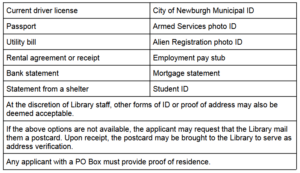
NON-NEWBURGH RESIDENTS
Any individual who lives in an area served by another RCLS member library must apply for a library card from their home library. A home library is defined as the library situated within the community where the patron’s primary residence is established.
Individuals who do not meet the eligibility requirements may still receive a card with
limited access and borrowing privileges depending on their residency, employment, or school enrollment status.
With varying restrictions, the Newburgh Free Library will also issue cards to:
- Non-residents who work or attend school in the service area
- Temporary visitors
- Organizations and outreach agencies
- Individuals in transitional housing
- Individuals with inadequate identification
These patrons may have limitations on the amount and type of materials they can check
out from the Library as well as the duration of their accounts. Individuals will be
informed of these limitations at the time of account creation.
LOST AND REPLACEMENTS CARDS
If a patron loses a library card they may request a replacement card from the Library.
Patrons are responsible for all materials borrowed on their card, all use of the card, and all charges made against it, until the card is reported lost to the Library.
FINES AND FEES
The Newburgh Free Library does not charge fines for most Newburgh Free Library
overdue materials; however, replacement costs for non-returned or damaged items will be charged to the patron’s account. The Library does not accept direct replacement of items. Other libraries may charge an additional processing fee.
LOSS OF LIBRARY PRIVILEGES
Patrons may not be able to check out materials if they owe more than $10.00 in charges of any type.
Borrowing privileges will be restored when the outstanding charges have been paid,
including the return of any overdue item and payment for any lost items.
ADDITIONAL NOTES
Library cards are subject to expiration and must be renewed before patrons can borrow
materials.
Patrons are expected to carry and present their card – whether physical or digital –
when using the Library. However, patrons may also use a photo ID provided that the
information on the photo ID matches the information in the Library’s database.
The Newburgh Free Library, in its role as the Central Library of the Ramapo Catskill
Library System, also abides by the most current RCLS Free Direct Access Plan, a
State-approved agreement between RCLS and the State Education Department’s
Division of Library Development of the New York State Library.
View a PDF of this policy.
Local History Collection Policy
Insofar as the Newburgh Free Library’s Local History Collection represents a separate and distinct collection from the Library’s general holdings, a separate and distinct set of policies are established to govern their selection and use.
PURPOSE OF THE LOCAL HISTORY COLLECTION
The purpose of the Library’s Local History Department is to collect, preserve, and make
accessible material related to the people, places, and events that have contributed to
the history of the City and Town of Newburgh, as well as the neighboring communities of New Windsor and Vails Gate, from early settlement by the Waoranek people of the Lenape tribe to the present-day.
SCOPE OF THE LOCAL HISTORY COLLECTION
The Local History Department collects historical materials in a variety of formats
including, but not limited to:
- Manuscripts, books, and other written and printed materials
- Photographs, prints, paintings and other visual materials
- Three-dimensional artifacts such as tools, clothing, and decorative arts
- Born-digital records, websites, and media files
FUNCTION OF THE LOCAL HISTORY COLLECTION
The Local History Department maintains both non-circulating print and archival
collections.
- Non-circulating Print Collection
Our non-circulating print collection includes published and un-published historical worksrelated to the City, and Town of Newburgh, as well as the surrounding communities of New Windsor, Cornwall, and Highland Falls. This collection also includes works that document the history of the Mid-Hudson region (primarily, Dutchess, Orange, Rockland, Sullivan, and Ulster Counties), as well as genealogical works that cover New York State and contiguous states. - Archival Collection
Our archival collection contains unique materials, including correspondence, manuscripts, works of art, photographs, and objects created by individuals or organizations directly connected to the City and Town of Newburgh, as well as the
neighboring communities of New Windsor, Vails Gate, and Balmville. Select items have been digitally reproduced and made available online, however these materials are irreplaceable and unique to our organization.
ADDITIONS TO THE LOCAL HISTORY COLLECTION
The Local History Librarian may base selection decisions on an item’s relevance to the overall scope and purpose of the collection. The Library Director approves the purchase of all materials.
GIFTS, DONATIONS, AND LOANS
Donations of materials will be accepted as an unrestricted gift after prior approval of the Local History Librarian and signing of a Deed of Gift between the donor and institution. The Local History Collection does not accept items on deposit.
The temporary loan of items to the Library for exhibition must be approved by the
Library Director. Insurance for any items on loan to the Newburgh Free library must be
carried by the lender.
Institutions seeking to borrow items from the Library’s Local History Collection for
exhibitions or other use must first receive approval from the Library Director.
The Local History Department may seek collection donations that expand upon the
overall scope and purpose of the collection. Potential donations are accepted at the
discretion of the Local History Librarian provided the Newburgh Free Library possesses the necessary resources – staff, finances, and storage to maintain the collection into the future.
CRITERIA FOR DEACCESSIONING
The Local History Department will not preserve records or artifacts about or pertaining to:
- Communities outside of the Town and City of Newburgh, and its surrounding
communities. - Individuals, families or businesses with no obvious connections or contributions to the Town or City of Newburgh and its surrounding communities.
- Mass-produced publications and newspapers distributed at the state, national, and international levels.
- Duplicated items that are represented by a similar item in better physical
condition. - An item which has physically deteriorated so that it is no longer useful or has failed to retain its identity or authenticity.
- Any item of lesser historical significance that does not communicate informational
values for research or exhibition purposes. - An item that cannot be properly preserved or cared for by the Newburgh Free Library.
Items will be deaccessioned by mutual agreement of the Local History Librarian and the Library Director. The item(s) may be disposed of in whatever manner is deemed appropriate and most beneficial to the Newburgh Free Library – which may include gifting to another archival or museum repository, destruction, or sale.
LOCAL HISTORY STAFF
As a discrete collection with special needs within the Library’s larger holdings, the staff
of the Local History Collection will be responsible for maintaining the collection. This work includes, but is not limited to: preservation and conservation of materials,
processing archival collections, promoting the collection through a variety of means,
such as creating flyers, creating website content, hosting programs, presenting
programs, and performing outreach. Local History staff will also be responsible for
training other Library staff in the proper handling of these archival materials and
conducting specialized reference work within the collection.
COLLECTION GOVERNANCE
The Local History Librarian is responsible for ensuring the Local History Department at the Newburgh Free Library adheres to the mission statement and this Local History
Collection policy. Taking into consideration the recommendation of the Library Director,
the Local History Librarian will determine the appropriateness of future collection
donations.
The Newburgh Free Library reserves the right to review and make changes to the
collection policy from time to time.
View a PDF of this policy.
Photography, Filming, Videography Policy
It is the policy of the Newburgh Free Library to permit filming and photography under the conditions described herein only to the extent that it does not interfere with the operations, programs, and activities of the Library.
The Library allows filming and photography in Library facilities as follows:
Classes or events sponsored by the Library may be photographed or video-recorded by the Library’s staff or its representatives. Attendance at a Library-sponsored class or event constitutes the consent of all attendees, and the consent of the parents or legal guardians of any minor children in attendance, to the future broadcast, publication, or other use of photographs or videos at the sole discretion of the Newburgh Free Library. Wherever possible, signage will indicate that a program is being filmed or photographed for Library purposes and consent forms may be distributed.
Casual amateur photography, filming, and videotaping is permitted at the exterior and in the interior of both the Main Library and Branch Library for patrons wanting a remembrance of their visit, provided that the photography does not interfere in any way with Library operations or capture any identifiable likenesses of individuals without their permission. Any such photographers are responsible for arranging all necessary releases and permissions from persons who are filmed or photographed.
Except as otherwise permitted by this policy, in no circumstances may anyone take a photograph or film a Library patron or employee without their consent or the consent of their parent/guardian, if a minor. While the Library is a public place, it is considered a “limited public forum” under federal law. Due to this classification, the Library prohibits photography and filming of patrons and staff when it disrupts library operations and the subjects being filmed have not given their permission.
Except as permitted by applicable law, no commercial or media photography or filming may occur in the Library without the prior written permission and approval of the Library.
Director. Such approval will contain the conditions under which the commercial/media photography or filming will take place and address the rights to ownership of the photos/films.
The Library may utilize photographs and videos from public programs and events at the Library and Library spaces on its website and in Library publications. Photos, images, and videos submitted to the Library by users for online galleries or contests may also be used by the Library for promotional purposes. To ensure the privacy of all individuals, including children, images will not be identified using full names or personal identifying information without prior written approval from the photographed subject, their parent or legal guardian.
Any consent granted pursuant to this Policy to permit photography or filming may be revoked at any time upon failure to comply with terms of the Policy or other rules and regulations of the Library.
View a PDF of this policy.
Printing and Copying Policy
PRINTING, COPYING, AND COPYRIGHT
The Newburgh Free Library provides photocopy machines and networked printers for the convenience and lawful use of Patrons
Patrons may not use personal paper in any Library printer or copier.
Patrons must perform their own formatting and design for any print or copier jobs.
Patrons monopolizing copiers or printers with overly large jobs may be asked to return later to complete their work if others are waiting.
COPYRIGHT
The Newburgh Free Library complies with federal copyright law (Title 17, U.S. Code).
It is the intent of this law to protect the rights of copyright owners from unauthorized reproduction of their works. This includes works that have been fixed in any format, including print, audio, video, and computer file, whether or not they have been published.
However, the law also recognizes the public benefit of allowing citizens to do limited copying from copyrighted works for educational purposes. Under the precepts of fair use (section 107), library patrons may copy or print parts of copyrighted works for one-time, educational, nonprofit activities. Copying that would replace or infringe upon a commercial sale of a copyrighted work (such as copying a work in its entirety, copying something for repeated use, or making exceedingly numerous copies of the same item) is forbidden.
In such cases, Library patrons should seek permission from the copyright owner before proceeding.
View a PDF of this policy.
Programming Policy
Library-initiated programs support the mission of the Newburgh Free Library to inform, enrich, and inspire our community by giving patrons additional pathways to access information, education, and recreation.
The Programming Policy reflects the philosophy expressed in the Library Bill of Rights and its interpretations, specifically Library-Initiated Programs and Displays as a Resource: An Interpretation of the Library Bill of Rights.
Library programs may take place on-site at the Library, off-site at other locations, or online. They may be provided by library workers, volunteers, or partners.
Library staff may use, but are not limited to, the following criteria in program planning:
- Relation to library mission and service goals
- Demographic data
- Popularity of collection materials
- Community needs and interests
- Historical or educational significance
- Presentation quality and treatment of content for intended audience
- Presenter background/qualifications/reputation
- Availability of program space
- Budget and staffing considerations
- Connection to other community programs, exhibits, or events
- Surveys and feedback forms from patrons
The Library may also co-sponsor a program with other agencies, organizations, and businesses, provided the programs are compatible with the Library’s mission to inform, enrich, and inspire our community.
External organizations or individuals partnering with the Library on programs must coordinate marketing efforts with the Library’s Marketing Department.
Guidelines for the selection and presentation of programs:
All programs are intended to further the mission of the Library and should address one or more of the following educational, recreational and/or civic needs:
- To increase awareness and the use of library resources
- To provide opportunity to widen horizons, stimulate imagination and reflection, and enlarge experiences
- To provide programs for various age groups, cultures, and interests
- To meet popular demand, both existing and anticipated
- To promote reading and lifelong learning
- To increase library use by under-served populations
- To educate and inform on a variety of topics usually with a focus on one or several of the following areas:
○ Literature and cultural heritage
○ Social awareness
○ Health and well-being
○ Information technology
○ Literacy
○ Current events and high interest topics
Library programs are open to the public.
Registration may be required for planning purposes or when space is limited.
Programs may be targeted towards a particular audience, such as children, teens or adults and will be advertised as such.
Patrons with special accommodation requests are encouraged to reach out to library staff prior to the event so accommodations can be made ahead of time.
Large groups wishing to attend a program must contact the Library first to ensure they can be accommodated.
Library staff may work with individuals or groups in the community to bring in presenters on a topic.
Presenters and library staff will work together to develop, promote, and deliver programs in accordance with the needs of both parties.
The library is not obligated to represent multiple and/or opposing viewpoints within any one program or series.
A program held at the library does not constitute an endorsement of the views expressed by participants.
While the Newburgh Free Library welcomes the opportunity to partner with local entrepreneurs, the purpose of programs may not be commercial or for the solicitation of business.
The Library may permit the sale of books or goods in conjunction with a library-sponsored program. All plans to sell such items must be arranged in advance and approved by the Library Director.
No program shall be permitted that endangers Library patrons, staff, Library facilities, or otherwise materially interferes with Library operations.
Any patron who would like the Library to reconsider a program that is sponsored or co-sponsored by the Library must submit a Request for Reconsideration form.
The Library reserves the right to deny attendance to anyone becoming disruptive to audience members or the program facilitator, and to anyone in violation of the Library’s Patron Code of Conduct
Program participants should expect that photographs/video will be taken at events and used on the Library’s social media sites and/or website.
View a PDF of this policy.
Service Animals Policy
A service animal is a working animal, not a pet. The Americans with Disabilities Act (ADA) defines a service animal as any dog that is individually trained to do work or perform tasks for the benefit of an individual with a disability, including a physical, sensory, psychiatric, intellectual, or other mental disability. Dogs that satisfy this definition are considered service animals under the ADA regardless of whether they have been licensed or certified by a state or local government, or any other entity. Here are some examples of tasks a service animal might perform:
Assisting with navigation, or stability and balance;
- Alerting to sounds or allergens;
- Pulling wheelchairs, carrying and retrieving items;
- Seizure assistance;
- Interrupting impulsive or destructive behaviors
Under the ADA and New York law [New York Consolidated Laws, Civil Rights Law – CVR § 47. Use of public facilities by persons with a disability], facilities that serve the public may not discriminate against individuals with disabilities. In addition, they must permit a service animal in all areas of the facility where patrons are allowed or the public is invited.
Library staff are not responsible for the care or supervision of a service animal and are not required to provide food or a special location for the animal.
A public accommodation provider cannot ask about the nature or extent of a person’s disability and may not demand proof that the animal is certified. However, if it is not readily apparent that a dog is a service animal, they may ask:
(1) if the animal is required because of a disability, and
(2) what work the animal has been trained to perform.
View a PDF of this policy.
Unattended Children and Vulnerable Adults Policy
The Newburgh Free Library strives to be a safe and welcoming place for all members of the community. This policy is created to ensure the safety and well-being of those children and vulnerable adults who use the Library.
CHILDREN
Parents and guardians are solely responsible for the care and supervision of their children while using the Library or attending Library programs.
Children under the age of 10 who are at the Library to use resources, attend programs, or take advantage of Library services must be attended by a responsible adult who is solely responsible for their care, supervision, and behavior. A responsible adult is defined as a parent, guardian, or caregiver over the age of 16.
Children ages 10-13 may use the Library unattended for a reasonable amount of time provided they are able to abide by the Patron Code of Conduct.
Young adults ages 14-17 may use the Library unattended, provided they are able to abide by the Patron Code of Conduct.
Regardless of whether they accompany their children to the Library or not, parents and/or guardians are responsible for the conduct of their children aged 18 or younger while on Library grounds.
Children who behave inappropriately may be asked to leave the Library.
Unattended children must have the telephone number of a parent or guardian to contact in case of emergency or any other circumstance where the child must leave the Library.
UNATTENDED CHILDREN AT REGULAR CLOSING TIME
If a child is left unattended at closing time, Library Staff will assist the child in contacting a parent or guardian. Parents must be aware of the Library’s regularly scheduled operating hours and make every effort to retrieve their child before closing. Staff are not to assist the child by transporting or escorting the child off the Library premises. The Librarian-in-charge and senior security guard will remain with the child while a parent or guardian is contacted. If a parent and guardian can not be reached after a reasonable amount of time, the local police will be called to take custody of the child.
UNATTENDED CHILDREN DURING EMERGENCY CLOSURES
If the Library closes early due to an emergency or inclement weather, the same guidelines outlined above are to be followed.
VULNERABLE ADULTS
A vulnerable adult is an individual over the age of 18 who is mentally or physically challenged to a degree that may significantly impair that person’s ability to provide adequately for their personal needs or manage their behavior without assistance.
Vulnerable adults must have a parent, guardian, or caregiver 18 years or older with them while in the Library that can manage their behavior and adequately provide for their personal needs.
Physically challenged adults capable of providing for their own needs are welcome to remain in the library without supervision so long as a contact person is available if the adult’s health or safety is in doubt.
The guidelines for vulnerable adults at closing time shall be the same as the guidelines for unattended children.
Violations of the Unattended Children and Vulnerable Adults policy may result in suspension of library privileges.
View a PDF of this policy.
Library Strategic Plan 2022-2026
Central Library Strategic Plan 2022-2026
Funds Will Support
- Acquisition of collections and databases, shared remotely with all member libraries and available in–house to central reference staff to assist them in supplying reference service to the region.
- Piloting new services and formats on behalf of all members.
- Marketing and promotion of services including reference and research assistance in collaboration with RCLS.
- Evaluation and consultation on database acquisition with committee of consortium members.
- Consultation with System and consortium members on marketing and promotion of resources.
- Identification and implementation opportunities for coordinated training on resources.
Request for Reconsideration of Library Resources
Authorized Use of Library-Owned Materials and Equipment Policy
The Board of Education permits the use of Library-owned materials and equipment (e.g.,laptop computers, cell phones, audio-visual equipment, etc.) by administrators and employees of the Library when such material and equipment is needed for Library-related purposes.
The Library Director shall establish regulations governing the loan and use of such equipment, including the individuals who may properly authorize the use of such material and/or equipment. Such regulations must address:
● that such material or equipment may not be used by the borrower for private, non-Library business purposes;
● the responsibilities of the borrower for proper use, care and maintenance;
● that all loaned equipment must be returned to the Library.
● that no item may be sold to or purchased by the borrower except in accordance with district policy and procedure on disposal of equipment.
All equipment shall be inventoried and a list shall be maintained of the date such equipment was loaned, to whom it was loaned, and the date of expected and actual return.
Individuals borrowing library-owned equipment shall be fully liable for any damage or loss occurring to the equipment during the period of its use, and shall be responsible for its safe return. In addition, since administrators and employees are issued Library-owned equipment in connection with their work responsibilities, the individual using the Library owned equipment shall not have an expectation of privacy with respect to information contained on the device (e.g., computer files, images, messages). Community members may only use Library equipment when at the Library for an authorized facilities use.
The Library Director or their designee shall maintain records of all equipment that is loaned for long-term use (e.g., school year, term of office, etc.) and shall review such list yearly.
View a PDF of this policy.
Confidentiality of Library and Patron Records Policy
The Newburgh Free Library’s commitment to privacy and confidentiality has deep roots not only in law, but also in the ethics and practices of the library profession.
In accordance with the American Library Association’s Code of Ethics:
“We protect each library user’s right to privacy and confidentiality with respect to information sought or received and resources consulted, borrowed, acquired, or transmitted.”
At the state level, New York State Law NY CPLR § 4509 states:
“Library records, which contain names or other personally identifying details regarding the users of public, free association, school, college and university libraries and library systems of this state, including but not limited to records related to the circulation of library materials, computer database searches, interlibrary loan transactions, reference queries, requests for photocopies of library materials, title reserve requests, or the use of audio-visual materials, films or records, shall be confidential and shall not be disclosed except that such records may be disclosed to the extent necessary for the proper operation of such library and shall be disclosed upon request or consent of the user, or pursuant to subpoena, court order or where otherwise required by statute.”
This policy outlines how the Newburgh Free Library works to maintain patron privacy, which is essential to the exercise of free speech, free thought, and free association.
GUIDELINES
1. Protected information includes, but is not limited to, records related to the circulation of library materials, computer database searches, interlibrary loan transactions, reference queries, requests for photocopies of library materials, title reserve requests, and the use of audio-visual materials, films, sound recordings, computers and wireless networks.
2. All library employees are advised such records shall not be made available or disclosed to any persons or entity, including any agency of state, federal, or local government except pursuant to such process, order or subpoena as may be authorized under the authority of, and pursuant to, federal, state, or local law relating to civil, criminal, or administrative discovery procedures or legislative investigative power, or as otherwise required by statute.
3. Notwithstanding anything above to the contrary, such records may be disclosed to the extent necessary for the proper operation of the library (as shall be determined by the Library Director) and upon the consent or request of the library user identified by such records.
SECURITY CAMERAS
The Library uses security cameras to ensure the physical security of its property, staff and patrons. Cameras will not be installed in areas where staff and public have a reasonable expectation of privacy, such as restrooms. Recorded digital video images may contain personally identifiable information about an individual who has used any library service or borrowed any library materials (“patron information”), and will be accorded the same level of confidentiality and protection provided to library users by New York State Law.
Video records and still photographs may be used by authorized individuals to identify those responsible for library policy violations, criminal activity on library property, or actions considered disruptive to normal library operations.
RECORD RETENTION AND DISPOSITION
Library records are retained and disposed of in accordance with the Retention and Disposition Schedule for New York Local Government Records (LGS-1).
LAW ENFORCEMENT REQUESTS
Library records containing personally identifiable information are confidential and shall not be disclosed, except as required by law. The Library Director or their designee shall be responsible for handling all law enforcement or similar requests to obtain confidential information held by the Library.
Staff members understand and seek to protect privacy rights at all times. Staff members approached by a law enforcement officer or anyone who requests information about another person’s library use shall refer all inquiries to the Library Director or their designee.
PUBLIC COMPUTERS AND WIRELESS NETWORK
The library does not keep a record of your activities on any public computer or on our wireless network. Any record of browsing history and activities on our public computers or wireless network are removed when you log out or disconnect. Information about your public computer reservation (library card number, computer number, reservation time, and session duration) is purged at the end of each day.
The library is not responsible for the privacy and security practices of non-library websites. Computer users should review each site’s policies and security practices and take other reasonable precautions when disclosing private information.
THIRD-PARTY VENDORS
The library works with third-party vendors to provide online learning, digital collections, streaming media content, analytics, and more. When you leave the library website, your interaction with these systems will be governed by their individual privacy policies. Some of these vendors may collect and share information you provide to them or require you to create a personal account in order to use their services. Check the vendor’s privacy statement and terms of service to learn more about how your data is tracked, stored, and used by them.
LIBRARY USE OF EMAIL
The Library requests email contact information in order to provide information about the Library’s services, upcoming events, as well as reminders about checked out materials. Any cardholder can decline to receive emails from the library at the time of registration, at a later date by contacting the Library, or by unsubscribing directly.
STAFF TRAINING
The Library Director will develop trainings for staff to ensure consistency in implementing this policy.
View a PDF of this policy.
Video Surveillance Policy
The Newburgh Free Library utilizes security cameras for the protection and safety of library visitors, employees, assets, and property; to deter public endangerment, vandalism, and mischief in unsupervised areas; for identifying persons breaking the law or violating the library’s Patron Code of Conduct or other policies; and for investigating documented accidents or injuries on library property.
The purpose of this policy is to establish guidelines particular to the Newburgh Free Library for the placement and use of security cameras, as well as the access and retrieval of recorded digital video images.
CAMERA LOCATIONS
Cameras may be installed in locations where individuals do not have a reasonable expectation of privacy. Examples of where cameras will operate include common areas of the Library such as entrances, near book and media collections, public seating areas, public meeting rooms, public computing areas, and areas prone to theft or misconduct, including some outdoor spaces.
Cameras will not be installed in areas of the Library where individuals have a reasonable expectation of privacy, such as restrooms or private offices, nor are they positioned to identify a person’s reading, viewing, or listening activities in the Library.
ACCESS TO SECURITY CAMERA RECORDINGS
Access to real time or archived security camera recordings is limited to the Library Director or their designee, Security Staff, Newburgh Enlarged City School District Director of School Safety and Security, and Information Technology staff.
Security camera recordings showing entry into the Library and/or use of Library services are confidential library user records, and will be accorded the same level of confidentiality and protection afforded to library user records under applicable local, state, and federal laws and Newburgh Free Library policies. Such footage will not be shared with any third party without consent of the library user, or per a judicial order or subpoena, unless such disclosure is determined by the Library Director or designee to be required for the purposes set forth in this policy.
Security camera recordings that are not considered confidential library user records (external recordings not depicting access to the Library) will be shared with a third party at the discretion of the Library Director or designee.
Security camera images of individuals who have been restricted from Library premises may be shared with library staff for purposes of enforcement and awareness; such images may not be reproduced or further shared without permission from the Library Director.Confidentiality and privacy issues prevent the Library from allowing the public to view security camera footage. If the Library receives a request from the general public to view recorded camera footage, the public will be advised to file a police report.
SIGNAGE
The Library will post appropriate signage at entrances to the Library notifying patrons and staff of the use of surveillance cameras.
The Library Director is authorized to develop further regulations and procedures as may be necessary to implement this policy.
View a PDF of this policy.