
Charity and Community in Our Archives
by Matthew Thorenz, Local History & Government Docs Librarian
On December 29, 1976, a holiday miracle was reported in the Times Herald Record. Following a radio announcement that Newburgh’s Meals-on-Wheels would be unable to deliver hot meals to those in need due to inclement weather, eight teamsters from Local 445 volunteered their services to deliver food to 40 individuals who needed it most. When asked about her thoughts on the response, Meals-on-Wheels chief Frederica Warner said “You just have to have faith”. Selfless acts such as this are not new to Newburgh, and this was not the most recent, but our archives hold records of many events, organizations, and individuals who did their best to support our community in trying times.

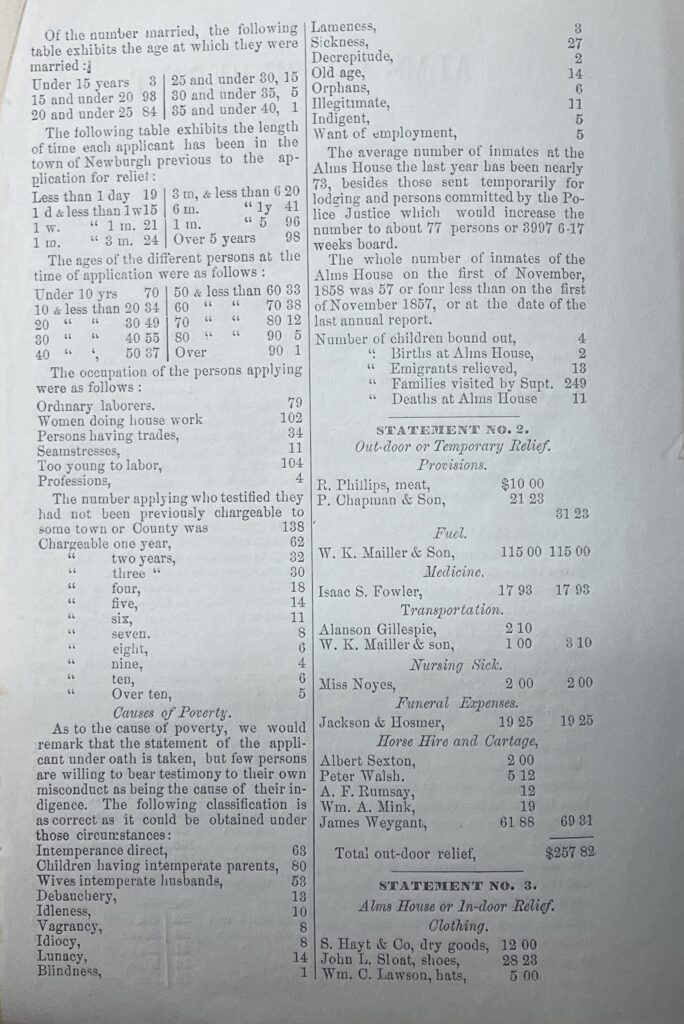
Cover and inset from the Sixth Annual Report of the Commissioners of the Newburgh Alms-House
Newburgh Free Library, Local History Department
An early example of charitable work instituted by our community exists in our transcribed copies of minute books and examination logs of the Newburgh Alms House, also known as the “Central Poorhouse”, and “City and Town Home”. Originally established in 1853, the Alms House grew out of a need to house adults in a separate facility from children, who were being cared for in the “Children’s Home”, a mansion that once stood where SUNY Orange now sits. These adults had either fallen on hard times, were elderly, or otherwise unable to care for themselves. Like the Children’s Home, the Alms House was overseen and funded by the Alms House Commissioners, and was located in the area of Lake and Williams Streets. The complex included living quarters as well as a working farm that was cultivated by those boarders who were still physically able to work.
The minute books give an insight into the activities of the Alms House Commission, including wellness checks, intakes, and agricultural activities, whereas the examination logs are rich in historical information for anyone interested in learning about who might have been cared for by the Alms House Commissioners between 1853 and 1873. These individuals included people like Isaac Brown, examined on April 15, 1853, a widower, and person of color, who required assistance to bury his three-year-old child despite having “labored during the winter for his support”; twelve year old Phebe Noyse, born in Newburgh and observed on April 23, 1853, whose “cause of poverty is her brothers cruel treatment of her, and driving her from her former home without sufficient clothing”; and Martha Vail, observed July 1, 1853 and, at age 67, described as “old and very infirm…she says she is able to do something for her support, has been assisted by private charity. She thinks she has the consumption. The church pays $24 a year for rent”.
As the city grew, so did those who needed care. Eventually the Alms House patients would be moved to other facilities, such as the City Infirmary, which could better meet individual needs, and by 1970 the Alms House, with many of its records still inside, was destroyed as a result of urban renewal, making the transcriptions and annual reports available at our library, as well as digital surrogates from the City Historian’s office on New York Heritage (Newburgh Municipal Records | New York Heritage) some of the few glimpses researchers have into the activities of one of our city’s earliest charitable organizations.
By 1876, a new organization would be formed with the goal to “bring into co-operation all existing charitable agencies, whether religious, civic, or of the public authorities, that the best interests of the poor may be secured, and that pauperism with its manifold evils may be overcome and reduced”. Known as The Associated Charities, this organization, housed at 39 Williams Street, served as part-employment office and part-adult education center for those looking to develop skills required for employment and independent living, including the homeless and formerly incarcerated. Unlike the Alms House commission, which consisted of individuals appointed to the post by the Town Supervisor, those interested in participating in the governance and oversight of Associated Charities only had to make an annual payment of $5 (approximately $160.00 in current money) or $50 ($1,640) for life. These proceeds would help fund programs such as cooking classes and the upkeep of the settlement house on 25 Williams Street.
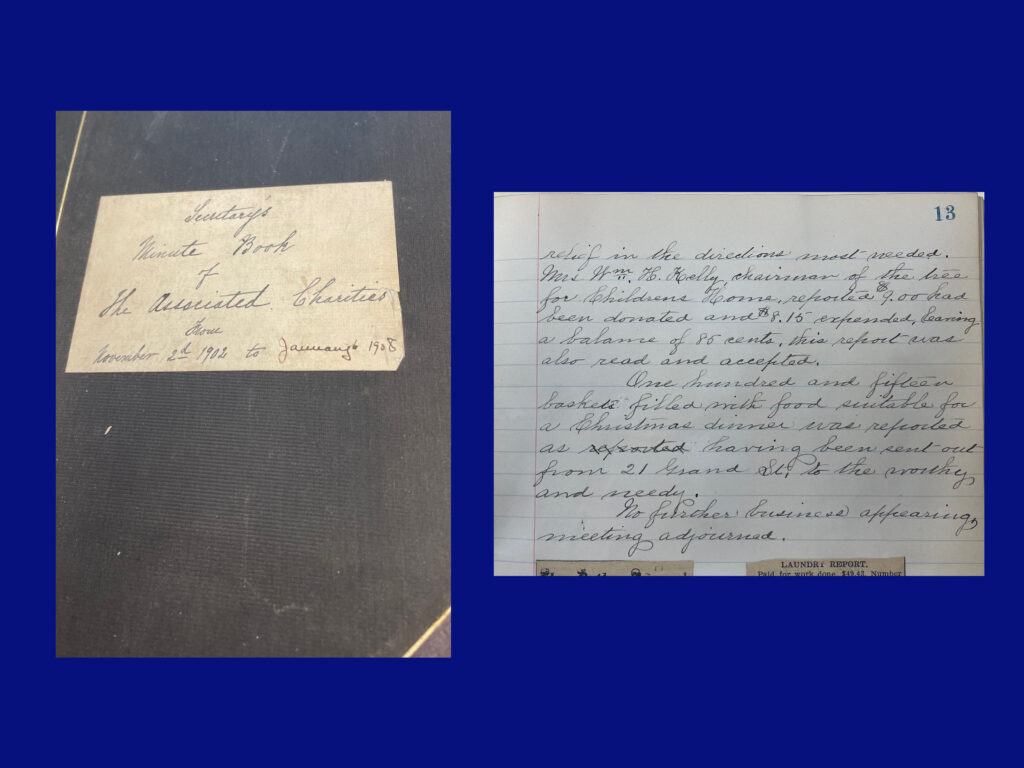
Cover and inset from the Secretary’s Minute Book of the Associated Charities
from November 2, 1902 – January 6, 1908
Newburgh Free Library, Local History Department
A surviving example of the work Associated Charities conducted was recently donated to our library by the City of Newburgh Historian’s office. The Associated Charities of Newburgh Minutebook records several of this organizations activities between 1902 and 1914. For example, a December 11, 1902 entry notes that “one hundred and fifteen baskets filled with food suitable for Christmas dinner was reported having been sent out from 21 Grand Street to the worthy and needy”. Another entry from 1914 notes the cooking classes that were being offered in the “Cooking Room” of the settlement house 4 nights a week. A newspaper article described one such class:
“Mrs. Taber, the cooking teacher, who has the happy faculty of keeping a number of very sociable ladies busy at one time. Those who did not care to do practical work-and they were in the minority- were most generously supplied with good things to sample by those who presided over the small gas stoves. Much merriment was caused over the artistic ability displayed in shaping and serving the croquettes, bet they were delicious “just the same”.
Although Associated Charities, Newburgh no longer exists, the organization’s home at 21 Grand Street continues to serve Newburgh’s population as a counselling center for Access Supports for Living.
Where associated charities provided lessons in cooking fresh food to the less fortunate, Newburgh’s Meals-On-Wheels chapter brings freshly prepared meals to people facing housing insecurity, the elderly, and other community members in need. Established in February, 1972, Meals-on-Wheels continues to be a lifeline to many residents throughout the city and town of Newburgh. The driving force behind the creation of this vital link to our community, Frederica Warner, began her career in volunteerism at the age of 10, when she joined Girl Scout Troop #7 in Newburgh. From there she would go on to volunteer for the YWCA, Human Rights Commission of Orange County, Habitat for Humanity, and Salvation Army, all while leading Meals-on-Wheels.

Newsclippings from a scrapbook kept by a member of the
YWCA Women’s Business Association of Newburgh
Newburgh Free Library, Local History Department
A memento of Frederica Warner’s community engagement is a scrapbook that once belonged to the YWCA’s Women’s Business Association of Newburgh. Established in 1924, this organization promoted local business and professional women through educational, cultural, and social activities. The club also sponsored scholarships and contributed to charities that benefited the community. While actively involved with Meals-on-Wheels, Frederica would herself serve as President of the “B&P Club” from 1996-1997 and participated in meetings, dinners, fashion shows, and other events as documented in this scrapbook. Our Local History Collection holds these and many other stories that document the history of community service and mutual aid in and around Newburgh. If you have a story to share or are interested in contributing to this growing collection, contact our Local History Department at (845) 563-3617, or via e-mail at newburghlocalhistory@rcls.org!